Monax Helical Pile Equipment

Purpose-Built for Interior Underpinning

Interior underpinning demands equipment that can deliver serious installation power without compromising access or maneuverability.

Helical pile equipment drives steel screw piles deep into the ground to stabilize and support foundations that have shifted, settled, or need to be leveled. It installs faster than traditional concrete piles and can be torque-monitored in real time.

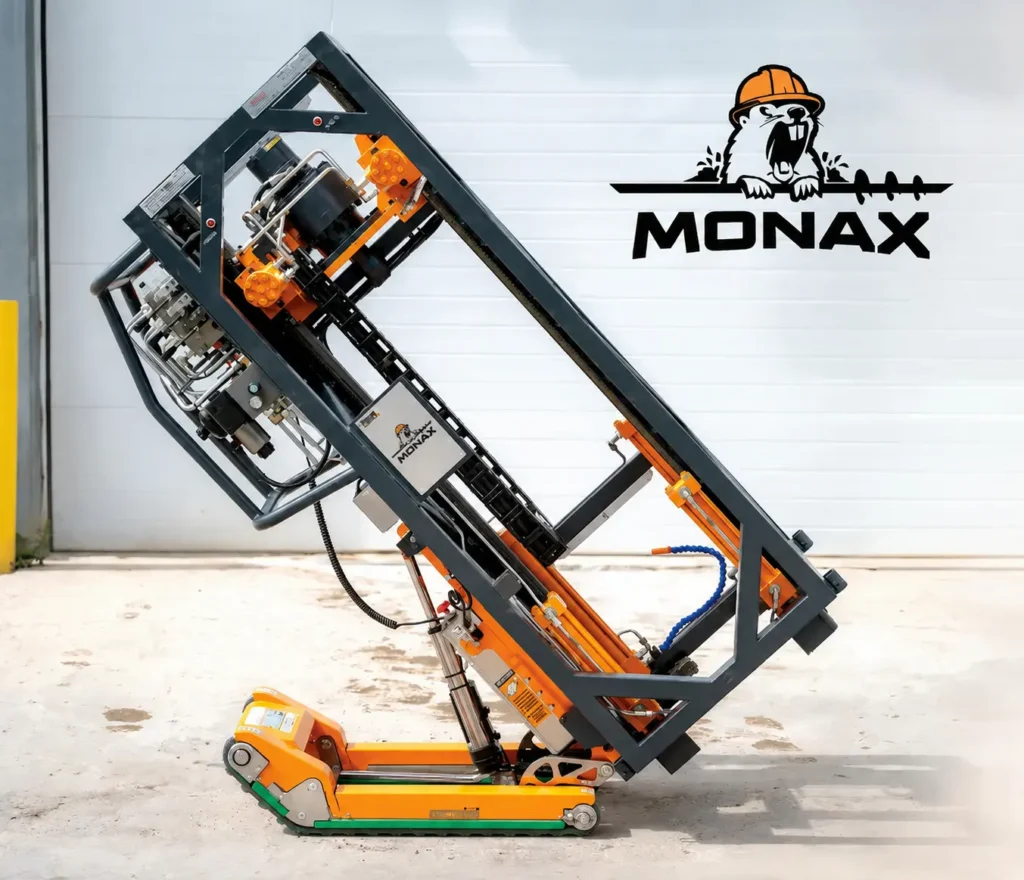
For decades, contractors installing helical piles inside existing structures have had to make a compromise: use equipment with enough power to get the job done, but small enough to fit through tight spaces and work inside a building. The Monax eliminates that compromise. It combines the power needed for demanding installations with the compact design and maneuverability required for interior underpinning.

Monax Helical Pile EquipmentUnderpinning Without the Excavation

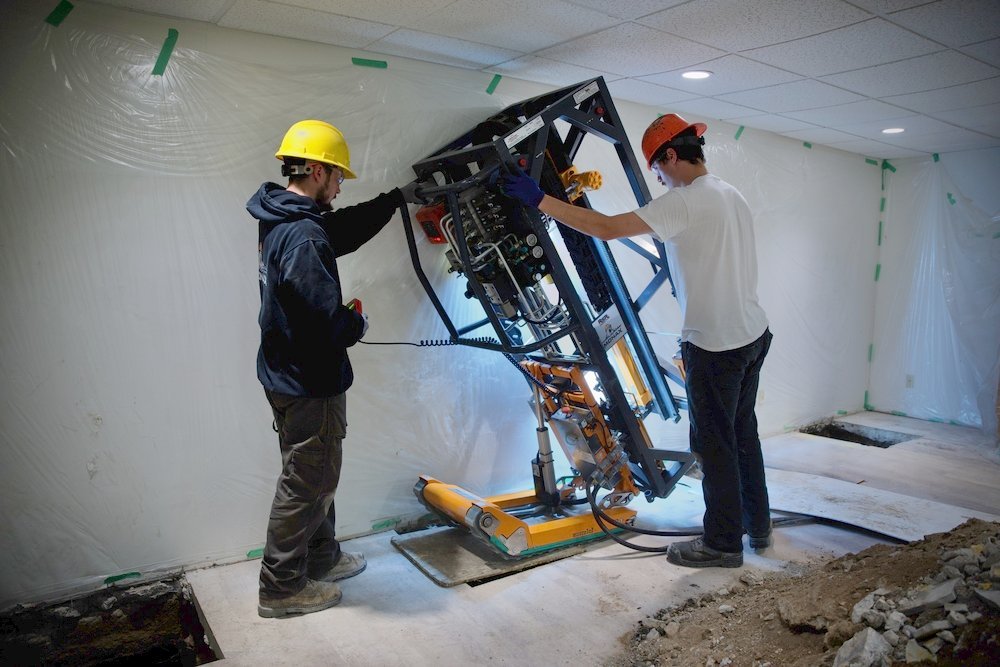
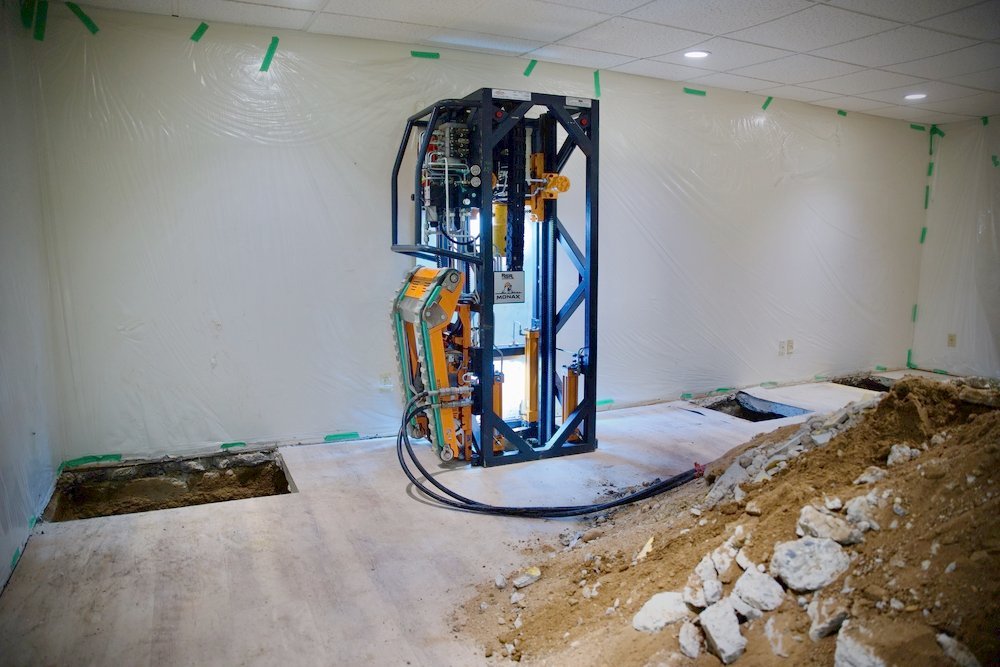
The patented Monax is unique. It is the only option in helical pile equipment built to self-anchor to a basement floor, climb stairs, and install from inside a structure, without exterior excavation, wall bracing, or a full crew to operate.
Most helical pile installation equipment falls into one of two categories. There are large machine-mounted drive heads that require exterior access and significant site clearance. The other category is handheld units or drive systems that solve the access problem but require a full manual crew, intense labour and are prone to pile yaw.

The Monax was made for the gap between those two options. It is the only portable interior helical pile machine of its kind, patented in the US, Canada, and Europe. It installs helical screw piles and anchors from inside a structure without exterior excavation. The machine fits through a standard doorway, navigates basement stairs on 360° crawler tracks, and delivers up to 8,040 ft-lbs of expected torque at 3,000 PSI.

The Monax anchors to the basement floor directly, with no wall bracing and no reaction arm fighting torque against a surface it shouldn’t be loading. For crews who’ve managed manual interior installs, that’s the detail that changes how the job is executed and completed.
For contractors, that means now you can bid on jobs that were previously impractical to take on. For building owners and property managers, residential or commercial, it means structural repair without vacating the premises, destroying the landscaping, or closing a business during installation.

Strengths and Benefits of the Monax Helical Pile Equipment

Two People. Full Installation.

Interior screw pile installation has historically required multiple people. Intense physical labour often results in physical injury, lost time, and slower install. That crew requirement sets a floor on what the job can cost, and what it can earn.

The Monax comfortably runs with only one or two operators. The machine handles the torque; the crew run the process. Based on RSR's own experience running Monax, that translates to up to 40% savings in labour cost compared to manual installation methods.
Access and Safety, Where Other Equipment Falls Short

Adapted excavators and compact remote-controlled rigs can handle some tight-access situations, but they can't navigate a standard basement staircase. They still need clearance that commercial office spaces, or finished basements and occupied homes don't always provide.

Handheld units go where the bigger machines can't. The tradeoff is that someone has to anchor the kelly bar against the wall. And they are also running the risk of bar swing out and injury.
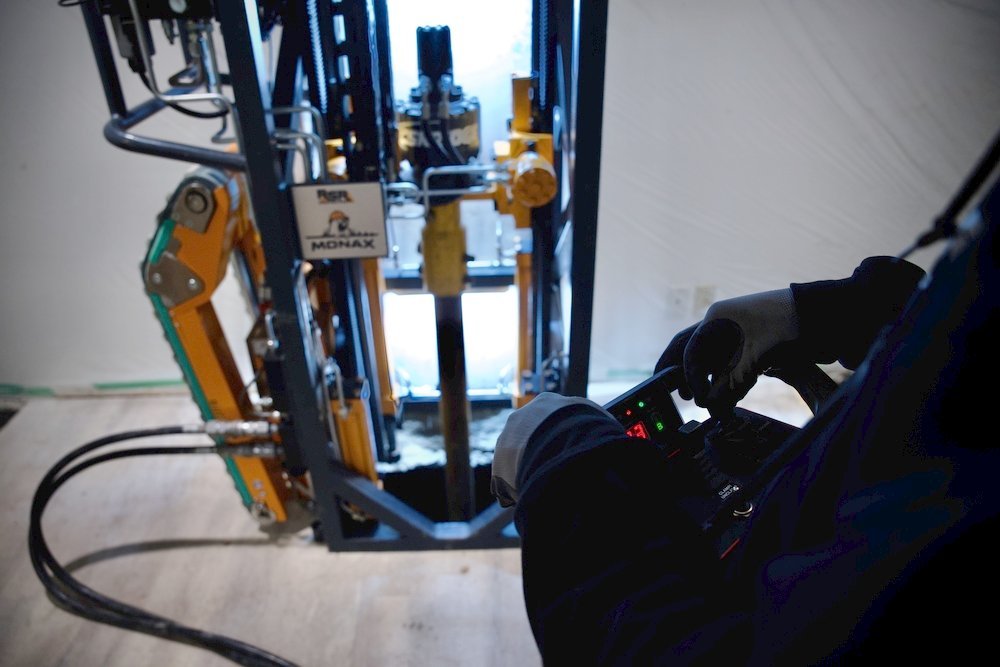
The Monax fits through openings as narrow as 25–26 inches and navigates 45+ degree stair angles. It self-anchors to the basement floor with as few as one anchor point, including on cracked or uneven surfaces. No wall anchoring means the torque load stays in the machine, not the structure. A remote-control option keeps the operator clear of the load during installation. The power plant stays outside, so there are zero emissions in the work area.
Foundation Lifting Is A Highly Profitable Service

Foundation Lifting Is A Highly Profitable Service Underpinning, or foundation lifting and stabilization, can be a highly profitable addition to your construction services. Buying the Monax for your business allows you to add profits to your business and differentiate yourself in a market where many contractors don’t offer it.

The Monax patented hydraulic piling system gives you the equipment and capability to add foundation lifting and stabilization to your existing services. The equipment has a quick payback plus you are opening the door to new revenue opportunities. Monax is a smart investment in growing your construction business.
The Monax installs 20–30 helical piles per day, with each pile taking 10–20 minutes from start to finish. Standard local depths run 20–30 feet, with verified installations to 148 feet. The Digga drive head delivers expected torque of 8,040 ft-lbs at 3,000 PSI. Vertical and horizontal controls maintain straight pile tracking throughout, eliminating the pile yaw that manual methods are prone to.
Field-Ready Extras

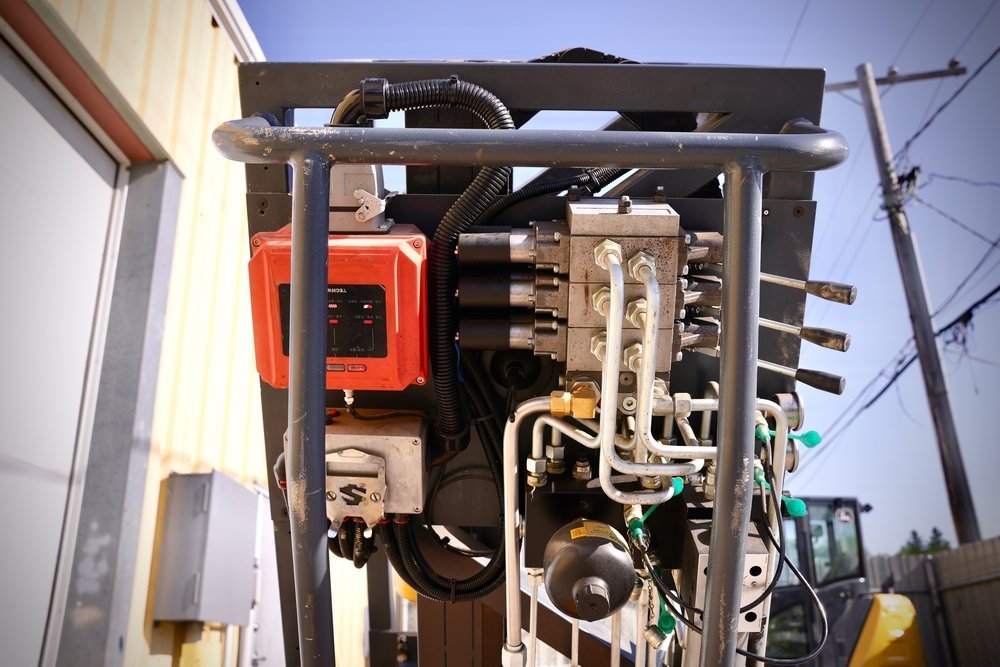
Built-in torque monitoring captures data through every install and exports it for engineer review. Additional features include:

  • Water lubrication nozzle that connects to any accessible tap
  • Waterproof LED lighting
  • Manual and remote control options
  • Frame designed for field repair, serviceable by any mechanically inclined operator or local hydraulic company
  • 24/7 support from RSR

Interior Installation: The Operational Case

For contractors, interior installation means bidding jobs that would otherwise go to someone else. Some of the most common interior underpinning jobs are also the hardest to reach: finished basements, occupied homes, commercial office space, tight urban lots, row houses, heritage structures, and sites with mature landscaping. Exterior equipment can't take most of these without adding disruption and cost that don't belong in the structural repair scope.
For the building owners and property managers on the other side of those jobs, interior installation means the repair happens without closing a business, moving the occupants, or writing a separate cheque for landscape restoration. The structural problem gets solved. Everything else stays the way it was.

Use Cases

The Monax is suited to interior underpinning jobs where exterior access is limited, restricted, or cost-prohibitive. This includes occupied residential foundations, commercial slab repairs and heritage structures where exterior excavation is not permitted.

Commercial and Residential Slab-on-Grade Foundation Repair

In commercial settings — warehouses, retail buildings, light industrial facilities, medical offices — interior slab repair is where the Monax’s business-continuity value is most visible. Commercial ceilings provide clearance, commercial slabs handle the load, and access through roll-up doors or freight corridors is straightforward. Work happens in a sectioned-off area while the rest of the building keeps operating. For residential slab-on-grade homes, interior installation avoids the exterior excavation and landscaping restoration that exterior alternatives typically require.
Result: The business stays open during repair. The property stays intact when the crew leaves.

Row Houses, Townhouses, and Zero-Lot-Line Properties

In attached and semi-detached urban housing, the type that’s common in older neighbourhoods across North America, there’s often no viable path for exterior equipment around the building. Side clearance is minimal and rear access may not exist. Excavating near a shared property line means neighbour consent, additional permits, and two lawns to restore. The Monax enters through the basement, works within the structure, and leaves the exterior untouched.
Result: Jobs that most foundation contractors quote impossibly high or decline entirely become viable without involving the neighbouring property.

Occupied Homes with Finished Basements and Mature Landscaping

Foundation settlement in a lived-in home creates a compounding problem. The structural repair is urgent, but exterior excavation means torn-up landscaping, irrigation damage, and weeks of disruption to a family without alternate living arrangements. When the engineer specs helical piles under a bearing wall or footing, interior installation is the cleaner answer. The Monax fits through a standard doorway, works from inside the basement, and keeps the power plant outside, so the home stays occupied throughout the repair.
Result: One small access cut replaces what would otherwise be a full exterior excavation. The foundation gets repaired. The property stays intact.

The Monax and Your Bottom Line

A two-person crew instead of a larger team changes the math on every interior job. Less labour, faster installs, and no exterior restoration costs add up to a meaningful difference in both project cost and project margin. Below is a breakdown of what that looks like in practice.

Dimensions (width/height/weight) Row 1, Content 1 Row 1, Content 2
Helix diameter capacity Row 2, Content 1 Row 2, Content 2
Depth range Row 3, Content 1 Row 3, Content 2
Torque rating / torque monitoring specs Row 4, Content 1 Row 4, Content 2
Power requirements (hydraulic drive details) Row 5, Content 1 Row 5, Content 2
Control options (manual/remote) Row 6, Content 1 Row 6, Content 2

FAQs: Helical Pile Equipment

Installing interior screw piles (also known as helical piles or helical piers) involves one of two approaches: handheld torque motors braced against a basement wall, or compact remote-controlled excavators adapted for tight access. Handheld motors require a full manual crew to manage the load and are prone to pile yaw under torque. Adapted excavators solve some access problems but still require significant clearance and can't navigate standard basement stairs.

The Monax was purpose-built for interior basement underpinning from the ground up. It self-anchors to the floor with no wall bracing required, and fits through a 25–26 inch opening. It climbs standard basement stairs and delivers machine-level torque with a two-person crew. It is the only interior helical pile machine of its kind, patented in the US, Canada, and Europe.

The Monax is available for purchase. Financing is available through First Capital Leasing. Contact RSR Construction directly to discuss options.
RSR offers a three-day on-site training course covering operation and maintenance. Video call training is also available for operators who can't travel to Regina. Most mechanically inclined operators are running independent installs within their first week. 24/7 support is available from RSR's service team after purchase. Most questions are resolved remotely, and many mechanical issues involve locally sourced parts that any hydraulic company can supply.
The Monax runs with two operators. Daily output ranges from 20–30 helical piles depending on ground conditions, with each pile taking approximately 10–20 minutes from start to finish. RSR's field benchmark in Saskatchewan clay is 20 piles per day. Production rates vary significantly by soil type and conditions. Using verified local benchmarks is recommended, rather than universal figures for project planning purposes.
Yes. The Monax is patented in the United States, Canada, and Europe. It was designed and built by RSR Construction founder Terry Paun, and RSR is the sole manufacturer. It is not available from any other source.
The Monax is reversible and can safely back out when encountering bedrock or boulders. Standard practice is to consult the project engineer, who will direct pile repositioning based on the obstruction and the engineered capacities chart. This is consistent with standard practice for any helical pile installation, and the Monax's torque monitoring data provides the engineer with a complete picture of what each pile encountered during installation.

Our philosophy is 100% customer satisfaction.

If you’ve encountered underpinning house shifting, extreme wall cracks or flooding within your home, we can fix the problem at the source.

Let's talk

This field is required.
Dropdown
This field is required.
Scroll to Top